

Protocol Deep Dive
Understand the protocol, cryptographic foundations, and architecture
Start Building
Integrate private payments into your app with our multi-platform SDKs
Watch the Explainer
A short visual walkthrough of how Privacy Boost keeps transfers private onchain while preserving app visibility and auditability.Who is this for?
On public blockchains, every transfer, every balance, and every counterparty relationship is visible to anyone. For applications handling real financial flows, this creates immediate business, competitive, and regulatory risk.Wallets
User balances and transaction history must remain private and never be broadcast onchain.
Stablecoin Networks
Payment and settlement flows require confidentiality between counterparties.
RWA Platforms
Institutional positions and counterparty identities are commercially sensitive.
Fintech Applications
Privacy must align with financial regulatory frameworks, not conflict with them.
Why Privacy Boost?
Sub-500ms Transactions
Server-side ZK proof generation inside hardware-isolated enclaves. With no client-side proving, Privacy Boost works instantly on any platforms, including mobile devices.
1,800+ TPS
Proof aggregation batches hundreds of transfers into a single onchain transaction, reducing gas costs by orders of magnitude.
Auditability
Authorized auditors can query specific accounts. Every audit access is logged immutably onchain. Privacy for users, accountability for regulators.
True Self-Custody
Your keys, your funds. Forced withdrawal lets you exit directly through the smart contract, even if every server goes offline permanently.
Instant Balances & History
A TEE-secured indexer decrypts and serves your balance and transaction history in real time. No blockchain scanning required.
Drop-In Integration
Works with MetaMask, WalletConnect, any EOA account and smart accounts. TypeScript, React, React Native, iOS, Android, and CLI SDKs, with no new wallet software needed.
Private DeFi
Use approved vaults and swap routes without publicly revealing your wallet, with your wallet identity hidden throughout the flow.
Demo
Try the live app →How It Works
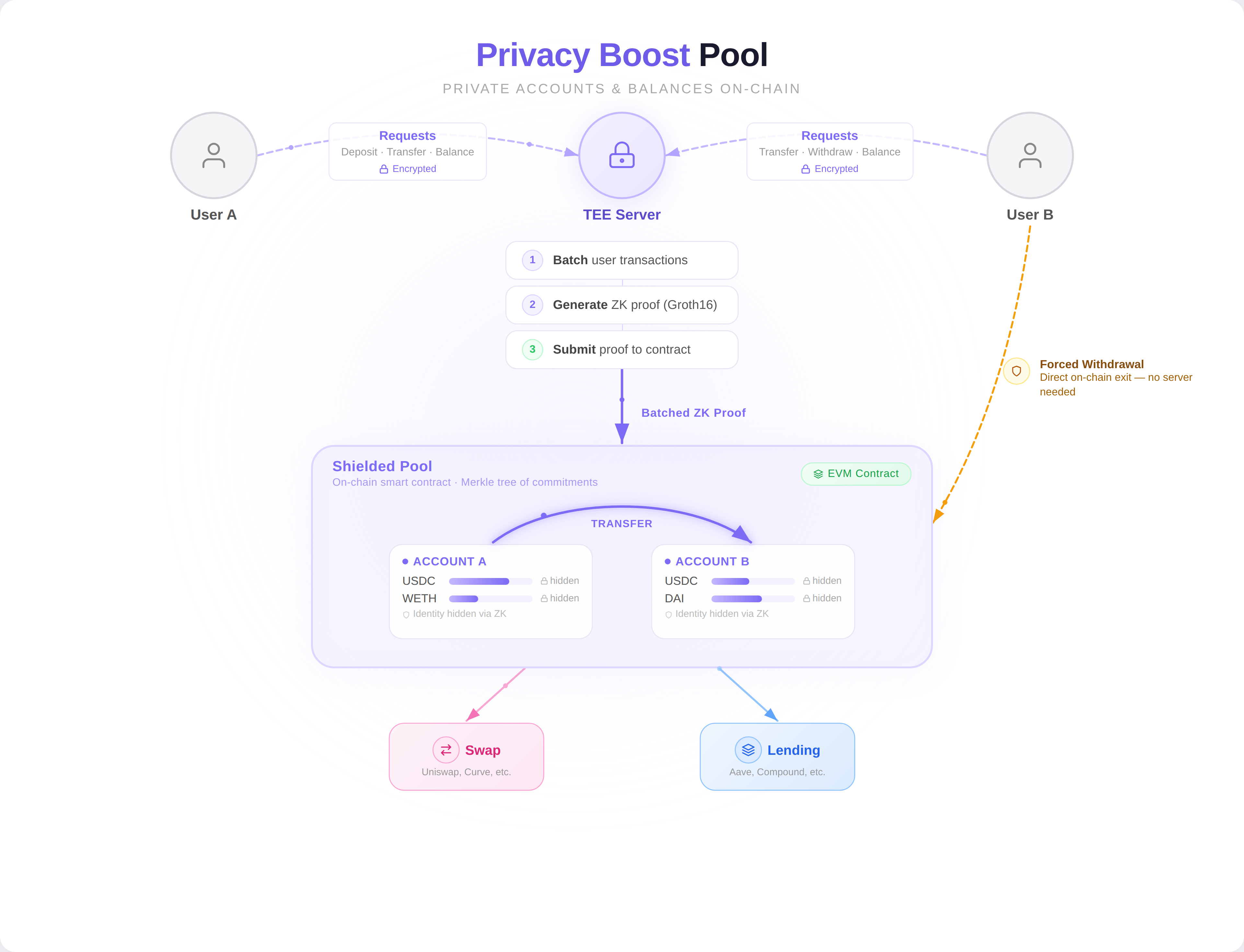
Why ZK + TEE?
Most privacy protocols force a tradeoff: client-side proving is trustless but costs 5–30+ seconds per transaction, can’t serve balance queries, and has no auditability. Privacy Boost combines both:- ZK proofs provide the privacy guarantees: sender, recipient, amounts, and token types are all hidden onchain. The smart contract verifies every proof and holds all funds. This is the cryptographic foundation.
- TEE handles what ZK alone can’t deliver: sub-500ms proof generation, instant balance and transaction history queries, and auditability through scoped audit access, all inside a hardware-isolated enclave.
Trust & Security Model
How the TEE works, what it can and can’t see, forced withdrawal, and the full threat model
More Ways to Move Funds
Available now in the SDKs. Audited by OpenZeppelin, see Audit Reports.Portal Deposit Addresses
A reusable public deposit address, similar to an exchange deposit address. Anyone can send supported ERC-20 tokens to it, and the protocol sweeps the funds into your shielded balance without revealing which shielded account was credited. Available on networks where the portal delegate is deployed, see Contract Addresses.
Claimable Transfers
Send privately to a wallet address, even if the recipient has not registered with Privacy Boost yet. The recipient can claim the funds by registering with that address, and the sender can request a refund after a set deadline while the gift remains unspent.
Coming Soon
DeFi Swaps
Swap between tokens straight from your shielded balance, private DeFi trading with your wallet never exposed.
Explore the Docs
- Understand the Protocol
- Start Building
Trust & Security
TEE guarantees, self-custody, forced withdrawal, and threat model
Auditability
How auditors query data with onchain accountability
Protocol Deep Dive
UTXO model, notes, nullifiers, Merkle trees, transaction lifecycle
Keys & Encryption
Key hierarchy, dual-path ECDH encryption, privacy addresses