

Shielded Pool Contract
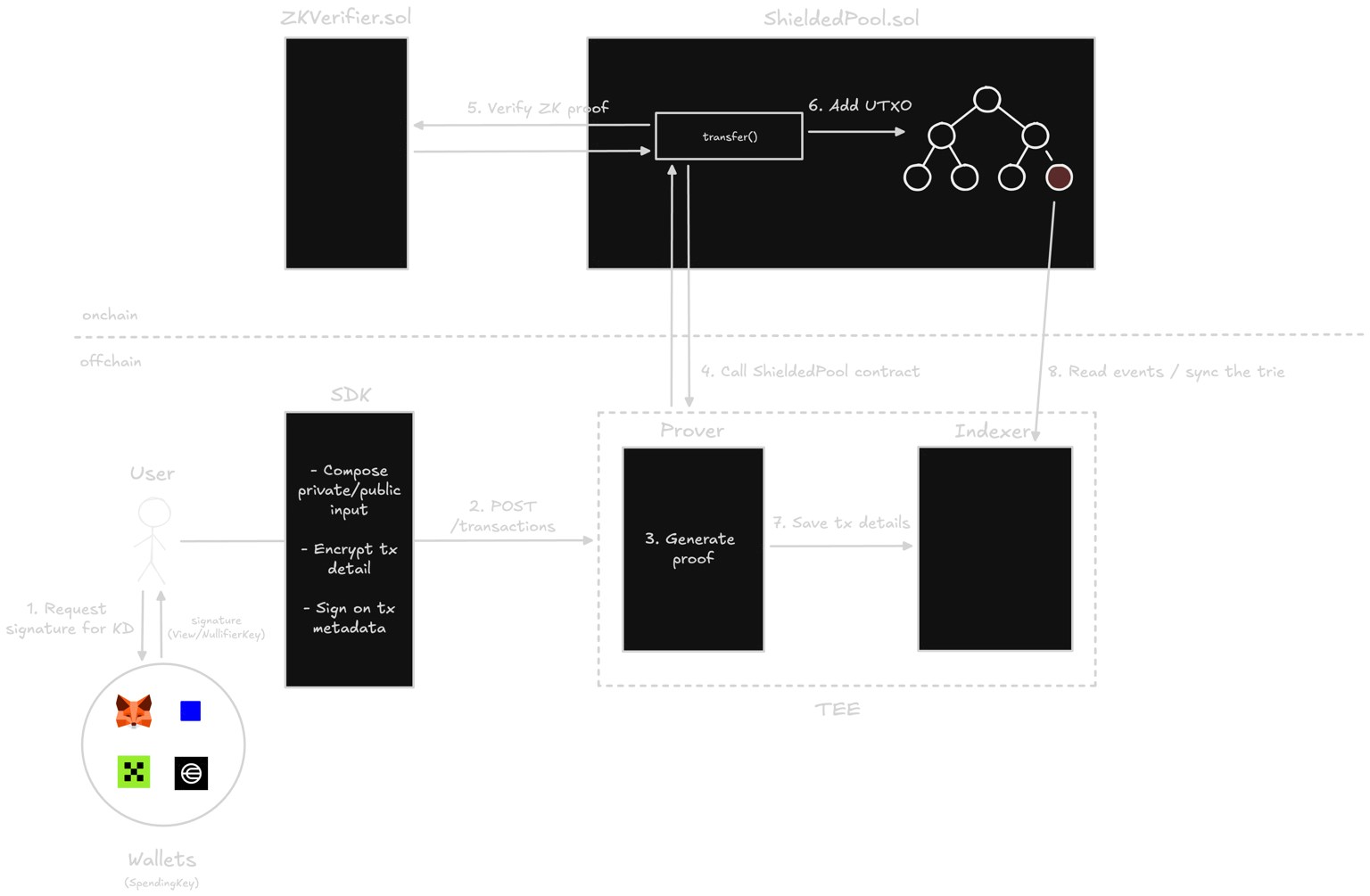
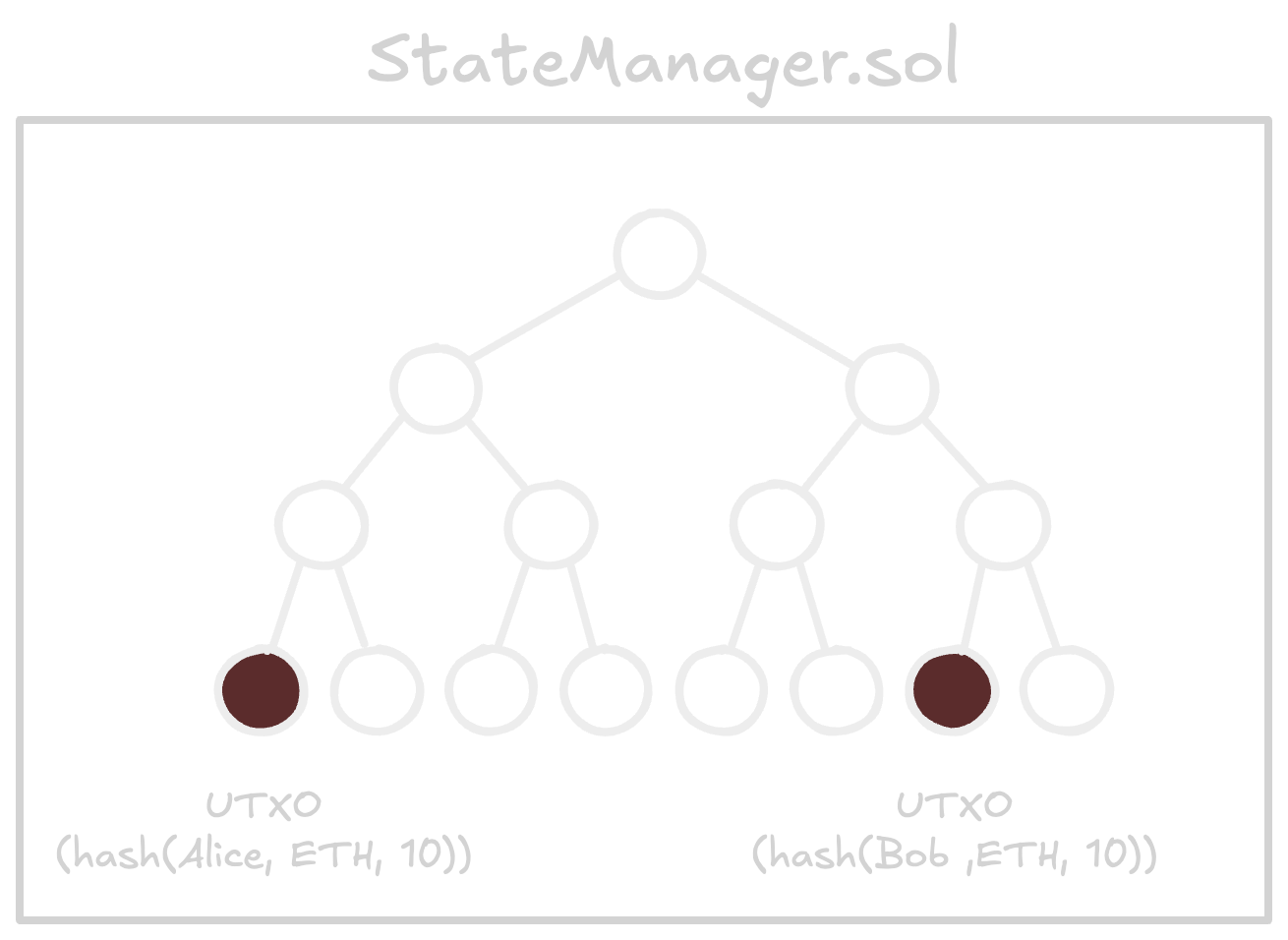
The Shielded Pool contract is the core component that manages the onchain state of Privacy Boost and performs the following functions.- Merkle Tree Management: It maintains a LeanIMT-based incremental Merkle tree, where each leaf consists of a UTXO commitment. Whenever a user performs a deposit or transfer, a new UTXO is inserted into the Merkle tree.
- Nullifier Registry: It maintains a nullifier mapping to mark UTXOs that have already been used. If the same nullifier is submitted again, the corresponding transaction is rejected.
- ZK Proof Verification: It verifies the Groth16 proof generated by the TEE prover and checks that the prover actually owns the UTXO and that a valid state transition has been requested.
SDK
The Privacy Boost SDK provides an integrated interface that abstracts all interactions between the onchain Shielded Pool contract and the offchain TEE infrastructure (TEE prover, TEE indexer) at the application layer. Through this, wallet and application developers can naturally integrate Privacy Boost functionality while maintaining the existing EOA-based key system, and users do not need to manage privacy-specific keys or a new wallet stack. The key functions provided by the SDK are as follows.-
Deterministic Key Derivation
Using a signature generated from the user’s EOA key as deterministic entropy, it automatically derives:
- Viewing Key
- Nullifier Key
- Input Aggregation and TEE Request Handling It collects user inputs (Merkle proofs, value, nullifier key, etc.) and securely sends them to the TEE prover. The SDK encapsulates TEE attestation verification, error handling, response parsing, authentication, and similar processes, allowing applications to request proof generation with simple function calls.
- Balance and State Query API It provides a high-level API to query user state (owned UTXOs, balances, transaction history, nullification status, etc.) maintained by the TEE indexer. Developers therefore do not need to implement complex logic such as event scanning or ECDH decryption.
- Zero-trust API The SDK enforces a zero-trust communication model by requiring remote attestation verification while interacting with backend TEE services. This guarantees that requests are served only by the intended TEE instance running the correct code, eliminating the need to trust offchain infrastructure operators or intermediaries. By handling attestation verification transparently within the SDK, Privacy Boost enables applications to safely transmit sensitive user data without exposing it to untrusted environments, while allowing developers to rely on hardware-backed guarantees without introducing operational complexity.
TEE Indexer
The TEE indexer identifies information such as the sender, recipient, and transfer amount for all transactions occurring within Privacy Boost, and maintains the user’s balance state and transaction history offchain. This serves 2 purposes:- To achieve instant UX by eliminating the need for users to scan all blockchain events each time.
- To securely store detailed transaction data (e.g. sender, recipient, token, amount) generated by the prover for regulatory audits and selective disclosure.
TEE Prover
The TEE prover generates a Groth16 proof based on the input provided by the user. The prover performs the following:- Verification of user signatures
- Full ZK proof generation, including Merkle proof verification, balance checks, nullifier calculation, etc.
- Delivery of transaction data to the indexer
- Onchain transaction submission on behalf of the user